What's Driving Delivery Demand?
Many investors expected the demand for courier delivery to revert sharply after the pandemic boom, and have been surprised by how well it's held up. What were they missing?
When this comes up in online settings, the most popular response is to mock these customers for being lazy or irrational, with the implication that their behavior is still unsustainable:
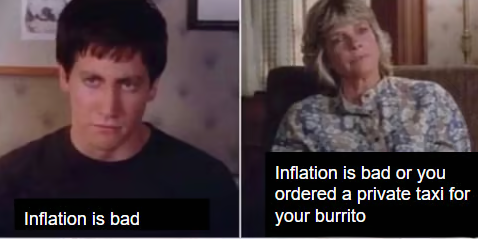
But of course, that's not a serious answer to the investment question—which involves millions of Americans across the demographic spectrum, and a variety of other factors. Let's walk through a few of them:
1) Less Time
Return-to-office mandates are an obvious factor here, but not the only one. Many Americans are doing shift work where their own hours have become less regular or predictable, and many stores and restaurants still have shorter or less reliable hours than pre-Covid. There are busy couples and single parents across the income spectrum who are finding it harder to juggle their kids' schedules, and so on.
So for a hypothetical customer, it may look silly to pay $30 in delivery fees and markups on $30 of fast food that they "could" have picked up… but with real customers, sometimes they couldn't have picked it up (much less cooked instead) and this was the best of a bad set of options.
2) Less Car Access
This one applies less to higher income brackets—but the rising cost of car ownership may be delaying it for younger customers, or leading more households to cut down from two cars to one. For example, even if a stay-at-home parent has time to shop during the day, their spouse may be using the only car to commute.
Remember that none of this is only about restaurants and groceries; it extends to many other retail segments where this courier delivery model is nipping at shipping/e-commerce use cases, or even converging with them. For example, this is Academy Sports last year:
Our initial analysis of the DoorDash data indicates that [it's] attracting a younger customer, along with customers who tend to live in more dense urban city centers where we don't have a large brick-and-mortar presence.
OK, would you pay $20 to have a baseball glove delivered in the next hour, when you could pay $10 to have it shipped in two or three days? That's usually a less time-sensitive problem than putting dinner on the table. But again, just note how fast these lines are already blurring. I'm writing this at 4PM, and I see that Amazon can get me a few different gloves by 8 AM tomorrow, and a much wider selection by the end of the day.
I don't need an emergency baseball glove, but I'm impatient and last-minute with some of what I do need, and I'll bet you are too. Not everyone has Prime, not everyone has a credit card, not everyone has a car. Everyone gets impatient.
3) Self-Control
Stores are getting better all the time at driving impulse purchases—to the extent that it's a running joke with some of them (like Costco) that you'll always spend more than you meant to, and often on frivolous or unhealthy items. Maybe more customers are realizing that it's better to pay that $30 in delivery fees and markups (and save an hour of your time) than to spend an extra $40 in the store.
Multi-channel retailers know that they're giving up this attachment when they push a customer online; it's one reason that the smart ones (like Costco) will sometimes lag on that front. But they do have offsetting advantages with delivery customers, and we'll get to those shortly.
4) Worse In-Store Experiences
Even as successful retailers get better at driving in-store attachment, many unsuccessful retailers are still cutting back on staffing and inventory, or increasing their markups on convenience items that would already be cheaper online. If a trip to the store is feeling more like a ripoff and a chore, with long lines and buggy self-checkouts, then it makes sense that more customers would pay to avoid it.
(This is a funny one for professional investors, who know that large corporate retailers will almost never attribute these drawbacks accurately. They'll keep reciting the net promoter scores and other marketing push polls, and taking credit for the cost savings; you'll only hear the bad news about understaffing from the new CEO, after the current one gets fired.)
5) Price Discrimination
When some hack on social media posts their "outrageous" DoorDash receipt as engagement bait, that has NEVER been less representative of other customers' experiences. For all the warranted concerns about "surveillance pricing," there are still some real efficiency gains from increased targeting, and real benefits for more price-sensitive customers—whether it's frequent coupons on the McDonald's app, or promotions in the delivery marketplace, or any number of other vectors.
Conversely, if you're an online "influencer" with picky and expensive tastes, the algorithms are increasingly designed to take advantage of that. Even for the rest of us, it's getting harder to generalize from our own experiences, or to reason from anecdotal evidence. In other words, one reason that other shoppers are willing to pay more than you'd expect for delivery is that they're not actually paying as much as you think.
6) Competition
This is bringing down all-in delivery pricing across the board, and maybe the best way to see it is with a heavyweight late entrant to one of the aggregator platforms—like Domino's on DoorDash, using their own drivers for fulfillment. Even just from browsing on one of those apps yourself, you can see how it's getting harder and harder for restaurants to get your attention and earn your order.
But to dig a little deeper, let's come back to those channel problems from #3. This is from one of my investor notes on Albertsons, back in 2021:
What's the real sustainable advantage of giving up in-store attachment to get customers to order online? I think we're starting to hear that answer already, and it's less about incremental retention or wallet share, and more about pricing.
I would add that selection is just as important to the pricing story as lower promotions—especially for supermarkets, where the online selection is always going to be a fraction of what's in the store. Even for other retailers with a lower SKU count and a seamless inventory back end, there's only so much you can display at once on a phone or laptop screen. So there's an inherent opportunity to nudge customers towards higher margin options just with selection and display decisions.
[So] there are ways to drive attachment online and drive pricing in the store, but at some point they come up against some basic limits of human attention and physics, [and] we're going to see more retailers drift towards these two basic principles: pulling an online or pickup customer into stores is a chance to sell them things they didn't plan on buying, which is exactly what stores have always been designed for. And pushing an in-store customer to online ordering is a way to charge customers a little more for what they already wanted.
See why it's not working? Here it is from Instacart last year:
People are increasingly comparing prices online… and as a result, we're working with almost all of our retail partners [on] reducing the markup, [or] going all the way to the same as in-store pricing… price parity retailers are growing 10 percentage points faster versus marked-up retailers. We know they retain better…
Of course, I was also talking about personalized selections and sorts, and other dark arts beyond just pricing. But the key insight is that the customer doesn't even have to perceive these tricks for them to be competed away.
It's a tricky point, so I'll give you a similar example on the e-commerce side. This is from my public note last year on third-party marketplaces:
One of my recent Walmart orders arrived in a Home Depot box, from a Home Depot warehouse. I’ve had a few similar funny experiences with drop shippers on Amazon or eBay, and maybe you have too. In this case, it looks like they scanned for products offered by Home Depot with free shipping, and marked them up as a third-party Walmart seller…
This third-party arbitrageur could be listing the same product on a dozen sites, and sourcing it from a dozen others. But I'm more likely to buy it at a site like Walmart or Amazon, where I'm already shopping across other categories. And I'm more likely to buy it from a seller who can quote a fast shipping time—even if I don't know who they are. [So] Home Depot doesn't even need their own "marketplace" platform to benefit from others implementing them. They just need scale and speed.
7) Adult Supervision
This one's a little tricky too—but investors were almost certainly underestimating the baseline (pre-Covid) demand for delivery, because the startups (going back to Webvan) were better at signing up new customers than servicing existing ones. This is how I put it in another investor note in 2024, when WMT was blowing away expectations for their new 1-3 hour delivery offering:
There are a surprising number of customers willing to pay $10 to Walmart for last-minute dinner ingredients; very few of them were willing to pay $20 to an unreliable startup with less of an assortment. In other words, it’s not just that all the failed delivery startups were deluding themselves about their inflated TAM estimates. Some of that inelastic demand for “convenience” was real, but the would-be disruptors couldn’t execute well enough to scale into it, and they left it on the table for the ultimate “incumbent” who could.
You can see how that’s not a story that anyone really has an incentive to tell. But it would help explain this surprising resilience in the survivors who kept scaling and muddling through, like UBER and DASH. And it might explain what we’re hearing from Walmart…
This isn't horseshoes, and close doesn't always count. We all know as customers that with a use case like last minute grocery orders, there's a massive difference between 90% fill rates and 90% on-time performance, and 95% or 98% on both metrics. If an app can only solve your problem four out of five times (90% x 90%), then you'll probably give up on it and drive to the store. Tech investors never saw the whole demand curve, because the startups could never get much past 90%. And now as the surviving platforms consolidate and catch up, it's no accident that you're hearing them talk more and more about things like fill rates and accuracy.